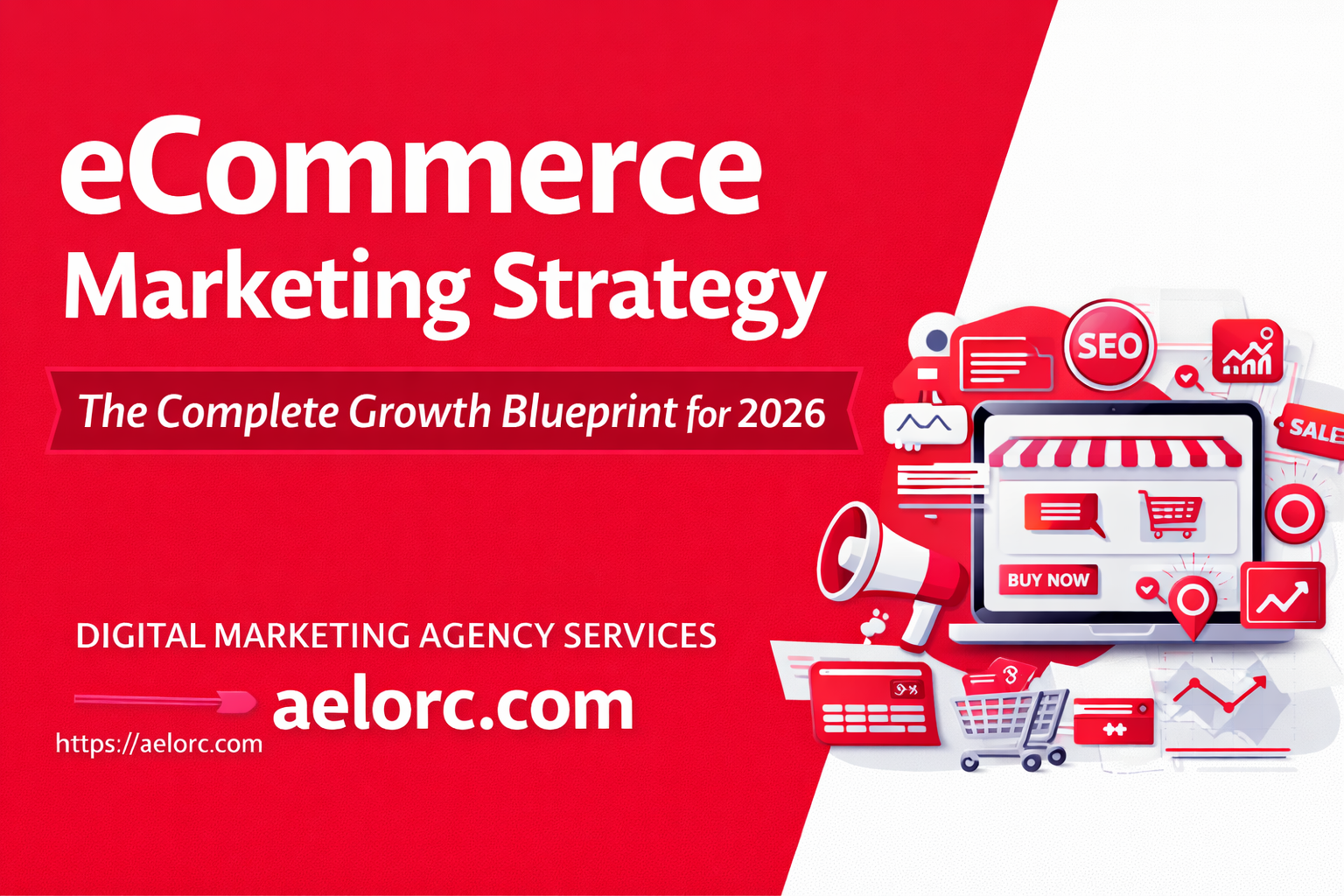
eCommerce Marketing Strategy Guide for Explosive Growth
Introduction: Why eCommerce Marketing Strategy Matters More Than Ever
The global eCommerce market is more competitive than ever. With thousands of online stores launching daily, simply having great products is no longer enough. What separates high-revenue brands from struggling stores is a well-defined eCommerce marketing strategy.
A modern eCommerce marketing strategy goes beyond ads and discounts. It integrates SEO, content marketing, paid media, CRO, email automation, social commerce, and AI-driven personalization—all aligned with customer intent.
In this guide, you’ll learn a step-by-step eCommerce marketing strategy designed to help online businesses grow sustainably in 2026 and beyond.
What Is an eCommerce Marketing Strategy?
An eCommerce marketing strategy is a structured plan to attract, convert, and retain online shoppers using digital channels. It focuses on the entire buyer journey—from awareness to repeat purchases.
Core goals of eCommerce marketing:
- Increase qualified website traffic
- Improve conversion rates
- Reduce customer acquisition cost (CAC)
- Build long-term customer loyalty
- Maximize lifetime value (LTV)
Step 1: Build a High-Converting eCommerce Foundation
Before driving traffic, your website must be optimized for user experience and search engines.
Key website optimization elements:
- Fast loading speed (Core Web Vitals compliant)
- Mobile-first design
- Secure checkout (HTTPS, trusted payment gateways)
- Clear product descriptions with keyword optimization
- High-quality product images and videos
💡 For deeper optimization insights, explore conversion-focused SEO guides on kairo360blog.com, where eCommerce UX and SEO best practices are regularly covered.
Step 2: SEO-Driven eCommerce Marketing Strategy
SEO is the backbone of long-term eCommerce growth.
On-Page SEO for eCommerce
- Optimize product titles and meta descriptions
- Use LSI keywords such as online store marketing, eCommerce SEO strategy, and product page optimization
- Add schema markup (Product, Review, FAQ)
- Write SEO-friendly category descriptions
Content Marketing for eCommerce
- Buying guides and comparison blogs
- How-to product tutorials
- Informational blogs targeting TOFU keywords
This approach aligns with Answer Engine Optimization (AEO), helping your content appear in featured snippets and voice search results.
Step 3: Paid Advertising for Scalable Growth
Paid ads accelerate results when combined with organic efforts.
Best paid channels for eCommerce:
- Google Shopping Ads
- Meta (Facebook & Instagram) Ads
- YouTube product ads
- Retargeting campaigns
A performance-driven approach ensures high ROAS. Many brands partner with a professional digital marketing agency to manage complex ad funnels and scaling strategies.
For example, agencies offering Digital Marketing Agency Services help brands structure profitable campaigns across platforms while reducing wasted ad spend.
Step 4: Social Commerce & Influencer Marketing
Social media is no longer just for engagement—it’s a direct sales channel.
Social commerce strategies:
- Instagram Shop and Reels
- Facebook product catalogs
- Influencer-generated content
- User-generated reviews and testimonials
These strategies improve brand trust and align with E-E-A-T principles, especially when creators demonstrate real product usage.
Step 5: Email & WhatsApp Marketing Automation
Email remains one of the highest-ROI channels in eCommerce.
Must-have automated flows:
- Welcome series
- Abandoned cart recovery
- Post-purchase follow-ups
- Re-engagement campaigns
WhatsApp marketing adds a GEO advantage, especially in regions like India, Southeast Asia, and the Middle East, where mobile-first shopping dominates.
Step 6: Conversion Rate Optimization (CRO)
Driving traffic without optimizing conversions leads to wasted budget.
CRO best practices:
- A/B test product pages
- Optimize CTA placement
- Add trust badges and reviews
- Simplify checkout process
Small CRO improvements can result in massive revenue gains without increasing traffic.
Step 7: Retention & Loyalty-Focused Marketing
Acquiring a new customer costs more than retaining an existing one.
Retention strategies:
- Loyalty programs
- Personalized recommendations
- Exclusive member discounts
- Subscription-based offers
Retention marketing strengthens brand authority and long-term profitability.
Step 8: AI & Data-Driven eCommerce Marketing
AI is reshaping eCommerce marketing strategies.
AI use cases:
- Predictive analytics
- Personalized product recommendations
- AI-generated ad creatives
- Chatbots for customer support
Platforms like Google Merchant Center and Meta Ads already integrate AI to improve performance, making data-driven decisions critical.
Local & Global GEO SEO for eCommerce Brands
If you sell in specific regions, Geographic SEO (GEO) is essential.
GEO optimization tips:
- Create location-specific landing pages
- Optimize Google Business Profile
- Use country-based keywords
- Localize content and pricing
This is especially important for brands targeting regional markets while scaling globally.
FAQs: eCommerce Marketing Strategy
What is the best eCommerce marketing strategy?
The best strategy combines SEO, paid ads, content marketing, CRO, email automation, and retention marketing, aligned with customer intent and data insights.
How long does eCommerce marketing take to show results?
Paid ads can show results within weeks, while SEO and content marketing typically take 3–6 months for sustainable growth.
Is SEO still important for eCommerce in 2026?
Yes. SEO remains one of the most cost-effective and high-ROI channels for long-term eCommerce success.
Should I hire a digital marketing agency for eCommerce?
If scaling becomes complex, partnering with experts offering Digital Marketing Agency Services helps improve ROI, performance tracking, and multi-channel growth.
External Resources
- Google Search Central – eCommerce SEO best practices
- HubSpot – eCommerce marketing trends
- Shopify Blog – Online store growth strategies
(External links should be added contextually in your CMS.)
Conclusion: Build a Future-Proof eCommerce Marketing Strategy
A successful eCommerce marketing strategy is not about chasing trends—it’s about building a systematic, data-driven, customer-focused growth engine.
By combining SEO, paid media, content, CRO, automation, and AI, brands can achieve sustainable growth even in competitive markets.
For more actionable marketing insights and strategy breakdowns, explore advanced guides on kairo360blog.com, where modern digital growth frameworks are consistently updated.
Strategic Partnering for Scalable eCommerce Growth
Executing a successful eCommerce marketing strategy often requires expertise across SEO, paid advertising, content marketing, automation, and analytics. As competition increases, many brands choose to collaborate with a professional provider offering Digital Marketing Agency Services to scale faster and more efficiently.
A full-service agency helps align marketing channels under one growth framework—ensuring consistent messaging, higher ROI, and measurable performance across platforms.
👉 Businesses looking for reliable and result-driven Digital Marketing Agency Services can explore solutions offered by Aelorc, a growth-focused digital agency that specializes in data-backed eCommerce marketing, SEO, and performance-driven campaigns.
🔗 https://aelorc.com
This type of partnership allows eCommerce brands to focus on product and operations while experienced marketers handle traffic acquisition, funnel optimization, and customer retention.
Why Professional Digital Marketing Agency Services Matter for eCommerce
Modern eCommerce marketing is complex. Algorithms change, ad costs rise, and customer expectations evolve. This is where Digital Marketing Agency Services add long-term value.
Key benefits include:
- Advanced SEO strategy for product and category pages
- Performance-focused Google & Meta Ads management
- Conversion Rate Optimization (CRO) for higher sales
- Email, WhatsApp, and automation workflows
- AI-driven analytics and reporting
Agencies like Aelorc combine technical expertise with industry experience to deliver scalable results, making them a strong choice for brands aiming to grow sustainably in competitive markets.
Integrating SEO, Ads & CRO Under One Growth System
An effective eCommerce marketing strategy works best when SEO, paid media, and CRO function together—not in silos. This integrated approach is a core offering of high-quality Digital Marketing Agency Services.
For example:
- SEO-driven content brings long-term organic traffic
- Paid ads accelerate visibility and product discovery
- CRO ensures traffic converts into revenue
When these elements are managed strategically—such as through a dedicated agency like Aelorc—brands see improved ROI and reduced customer acquisition costs.
🔗 Learn more about integrated Digital Marketing Agency Services here:
👉 https://aelorc.com
Final CTA
If you’re serious about scaling your online store in 2026 and beyond, investing in professional Digital Marketing Agency Services can be the difference between stagnant growth and consistent profitability.
With a results-driven approach to SEO, paid media, and automation, agencies like Aelorc help eCommerce brands build sustainable digital growth engines—backed by data, experience, and execution.